
Фонограма танцю
Kryvuliak
- Походження:
- Tarasivka Village, Kamianets-Podilskyi District, Khmelnytskyi Oblast
- Хореографія:
- Composition – Oleksandr Nebesny Revival – Serhiy Pedan, recipient of Ukraine’s Excellence in Education Award Arrangement – Ihor Pokhodoshchuk
- Виконує:
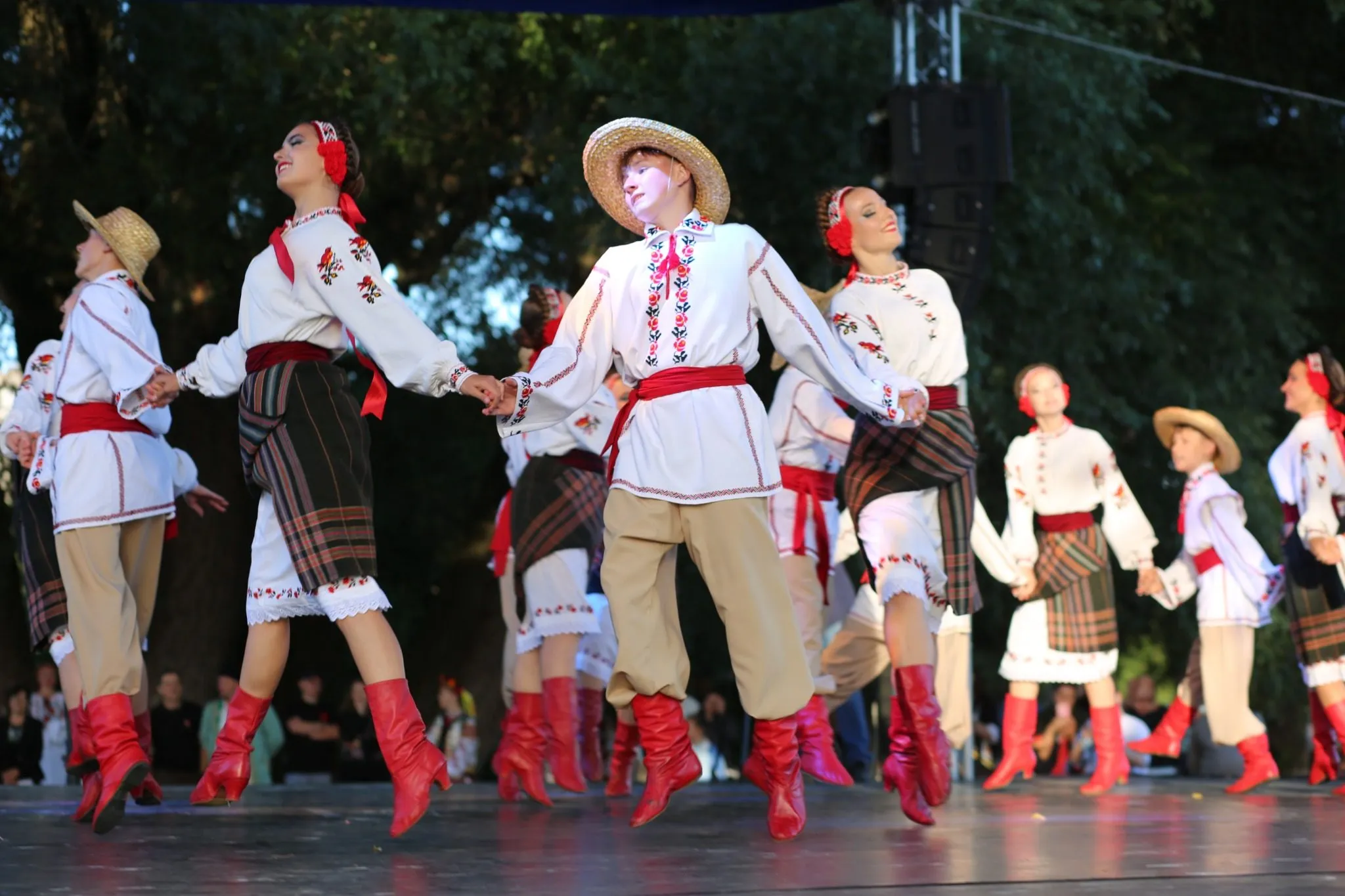
- The “Vesnyanka” Folk Dance Ensemble of Khmelnytskyi Gymnasium No. 24, directed by Yevhen Mandziy.
The Podilian dance "Kryvuliak" was recorded in the village of Tarasivka, Kamianets-Podilskyi District, Khmelnytskyi Region, by Petro Havryliuk, a lecturer at the Kamianets-Podilskyi College of Cultural Education. In 1979, the dance enriched the repertoire of the college's " Podilski Vizеrunky" (Podilian Patterns) folk dance ensemble. Until then, neither the name nor the dance "Kryvuliak" had appeared in the registry of Ukrainian folk dances. With the support of Petro Havryliuk, Oleksandr Nebesnyi staged the dance for the "Podillia" Folklore and Ethnographic Ensemble affiliated with the Khmelnytskyi Regional Department of Vocational Education.
Опис проєкту
DANCE DESCRIPTION: “ BAKOTCHANKA” (a traditional Podillia folk dance)
Choreography – Oleksandr Nebesnyi
Revival – ballet masters: Iryna Shtohrina, Oleh Popyk, and Serhii Pedan,
Music – folk, arrangement – Ihor Pokhodoshchuk.
Performed by: The “Vesnianka” Folk Dance Ensemble of Khmelnytskyi Gymnasium No. 24, directed by Yevhen Mandzii.
Duration – 4:30 min.
History of creation: “Bakotchanka” is an ethnocymonym meaning a woman or girl who was born or lived in the famous historic village of Bakota (one of the villages flooded in 1981 during the construction of the Dniester Hydroelectric Power Plant) in the Kamianets-Podilskyi District of the Khmelnytskyi Region. In his work, O.O.Nebesnyi drew inspiration from the distinctive traditions, way of life, and folklore of the Dniester region. The dance captures the grace, character, and vitality of the local girls and women – the Bakotchankas. It was one of the first dances created for the “Podillia” folklore and ethnographic ensemble, founded by the choreographer. At one of the amateur arts performances held in the 1980s, the dance “Bakotchanka,” performed by the ensemble, attracted considerable interest from choreographers.
The creation of “Bakotchanka,” based on the characteristic movements of traditional dance, has become a choreographic tribute to the people and the village of Bakota.
DESCRIPTION OF THE DANCE
An unlimited number of couples participate in the dance.
Before the dance begins, the couples form a large circle (Fig. 1), with the young women on the right and the young men on the left. The man holds the woman’s right hand with his right hand and her left hand with his left; their arms are crossed in front at first position.
Four measures of the musical introduction are played.
First Figure (16 measures)
The first figure of the musical accompaniment is played.
Figure 1
Measures 1-2. Couples take four regular steps forward on the right foot in a counterclockwise circle. As they move, they sway slightly with their hands clasped.
Measures 3-4. Couples perform movement No. 1 on the right foot.
Measures 5-6. Couples take four regular steps backward on the left foot, swaying their joined hands.
Measures 7-8. Repeat movement No. 1 on the left foot. At the end of the 8th measure, they separate their hands. The girls lower their arms along their sides. The boys clench their fists and place them on their waists, simultaneously turning 180º to the right (Fig. 2).
Measures 9-12. The dancers repeat the movements from measures 1-4. The young women move counterclockwise, and the young men move clockwise.
Figure 2
Measures 13-16. The dancers repeat the movements from measures 5–8. At the end of measure 16, the young women and young men turn to face each other (Fig. 3).
Second figure (16 counts)
The second figure of the musical accompaniment is played.
Figure 3
Measures 1-2. All dancers perform movement No. 2 starting with the right foot. Hands on the waist; they look at each other.
Measures 3-4. All dancers repeat movement No. 2 with their left foot.
Measures 5-8. The young women and young men perform “do-za-do” (movement No. 3), lowering their arms along their sides.
Figure 4
Measures 9-16. Dancers form pairs: the young man holds the young woman by the waist with his right hand, and the young woman’s left hand rests on the young man’s right shoulder. Their free hands are joined and extended to the side at second position.
The pairs perform a polka (movement No. 4), circling in place; the young men start with their right foot, and the young women with their left. At the end of the 16th measure, all dancers form a single circle (Fig. 4), with the young woman on the right and the young man on the left. Hands are joined at second position, elbows bent and pointing downward.
Third figure (16 measures)
The third figure of the musical accompaniment is played.
Figure 5
Measures 1-2. The dancers take four regular steps in a counterclockwise circle. As they move, they sway their joined hands.
Measures 3-4. The dancers turn to face away from the center and take four regular steps backward in the same direction (counterclockwise).
Measures 5-6. Repeat the movements from measures 1–2.
Measures 7-8. The young woman moves to the other side (from right to left) and stands to the left of her partner; the young man continues moving in a circle.
Measures 9-14. The dancers repeat the movements from measures 1–6.
Figure 6
Measures 15-16. The young woman moves from left to right and stands to the right of her partner. At the end of measure 16, all dancers form pairs as at the beginning of the dance and turn to face the circle (Fig. 5).
Fourth Figure (16 measures)
The first figure of the musical accompaniment is played.
The dancers repeat the movements of the first figure, moving toward and away from the center of the circle (Fig. 5). At the end of the 16th measure, all couples stand as shown in Fig. 6.
Fifth Figure (16 measures)
The second figure of the musical accompaniment is played.
The pairs repeat the movements of the second figure (Fig. 6). At the end of the 16th measure, all performers form a large circle.
Sixth Figure (16 measures)
The third figure of the musical accompaniment is played.
All dancers repeat the movements of the third figure.
DESCRIPTION OF MOVEMENTS
Movement No. 1. The basic movement of the “Bakotchanka” dance
Starting position – first straight position, arms at the sides.
Measure 1. On “one-and” – bend the right knee and step onto the ball of the foot, crossing it in front of the left leg; simultaneously turn the head to the right.
On “two-and” – bend the right knee and step to the right and to the side on the ball of the foot; simultaneously turn the head to the left.
Measure 2. On “one-and,” bring your right leg next to your left in the first straight position, turning your head straight in the direction of movement.
On “two-and” – lift your left leg to shin height. Keep your knee bent and pointing forward; keep your head in the previous position.
Perform the same movement with your left leg.
Movement No. 2
Starting position – third position, right foot forward.
Measure 1. On “one-and” – step with your right foot to the right, shifting your body weight onto it.
On “two-and” – bend your left knee and place it on the balls of your toes behind your right foot, shifting your body weight onto it.
Measure 2. On “one-and” – take another step with your right foot to the right, shifting your body weight onto it.
On “two-and” – place your left foot on its heel on the left side.
The movement is performed in the same way starting with the left foot.
Movement No. 3 “Do-za-do”
Starting position – dancers stand in pairs facing each other, feet in the first straight position.
Measure 1. The dancers perform standard steps with the right foot forward and to the left, meeting with their right shoulders.
Measure 2. The dancers continue moving to the right with their backs to each other.
Measure 3. The dancers step backward, meeting with their left shoulders.
Measure 4. The dancers move to the left and return to the starting position.
While performing the movement, partners look at each other.
The movement is performed in the opposite direction in the same way.
Move No. 4: Polka
Starting position – first straight position, hands on the waist.
On the downbeat “and” – lift the right foot slightly off the floor.
On “one” – jump onto the right foot, bending the left knee slightly backward.
At the same time, tilt your torso slightly to the right and turn 90º to the right. Look to the right.
On “and” – lightly tap the toe of your left foot next to your right foot, then immediately lift your left foot off the floor and bend it backward at the knee.
On “two” – hop on your right foot, keeping your left foot in the previous position. With your torso tilted to the right, turn 90º.
On “one” – pause.
Perform the same movement starting from the left foot.
Аудіопрогравач із фонограмою
Прослухайте фонограму танцю. Використовуйте її для навчання або виступів.
Навчайтеся танцювати разом з нами!
Покрокові відеоуроки допоможуть вам опанувати рухи подільських танців
Перейти до вивчення танцю