
Фонограма танцю
Pleskun
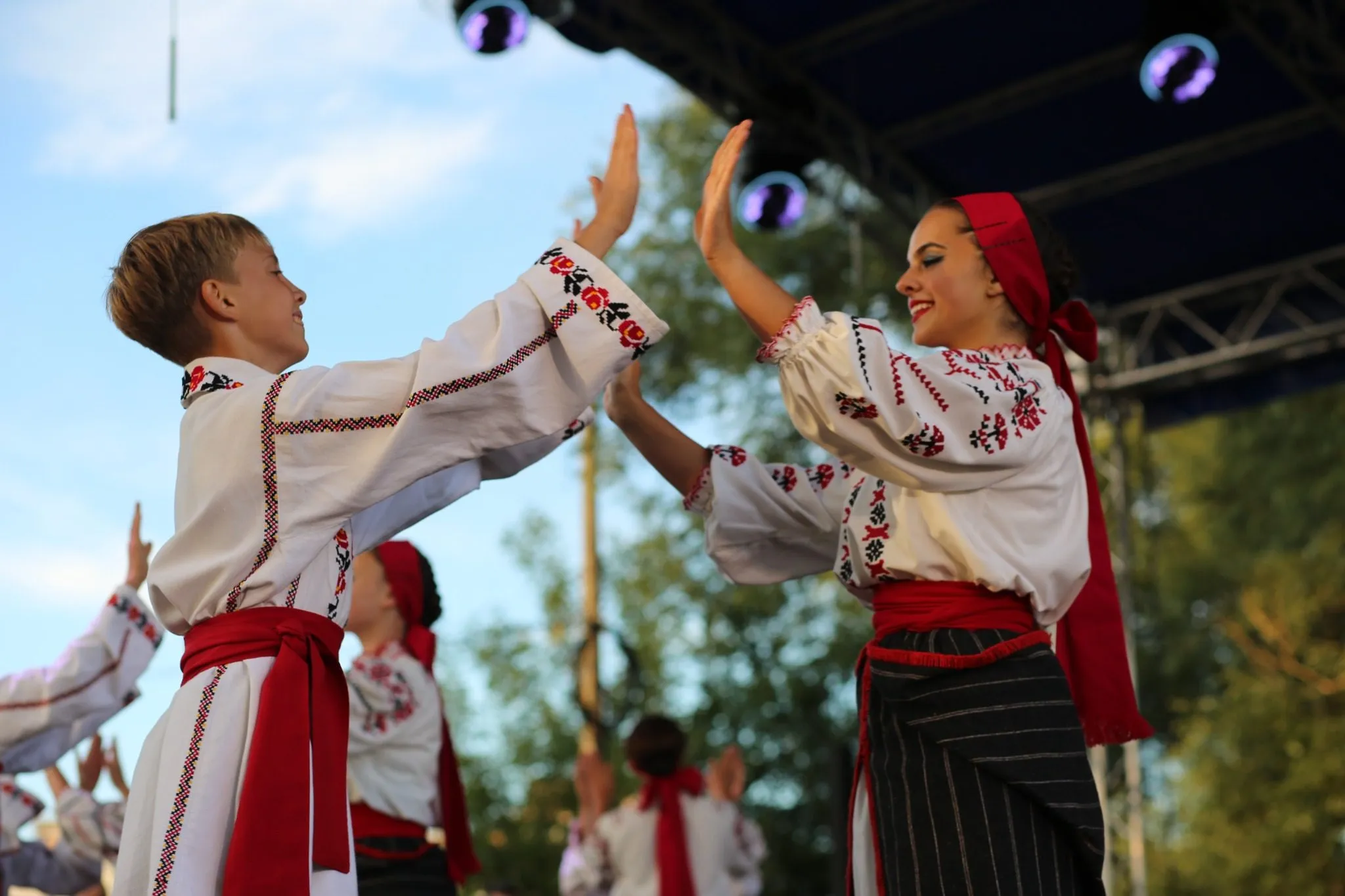
- Походження:
- the village of Pylypy, Vinkovets District
- Хореографія:
- Resolution — Vladimir Titov Restoration — Iryna Shtogrina, winner of the Bohdan Khmelnytsky City Award; Arrangement — Ihor Pokhodoshchuk
- Виконує:
- The “Namisto” Model Folk Dance Ensemble of the Khmelnytskyi City House of Culture, directed by Iryna Shtogrina, and the “Vesnyanka” Folk Art Dance Ensemble of Khmelnytskyi Gymnasium No. 24, directed by Yevhen Mandziy.
Halyna Furman, a folklorist at the Vinkivtsi District House of Culture, recorded the dance movements of the everyday folk dance - hand-clapping ("pleskania v doloni") and energetic polka-style (“polechka”) twirling in pairs—in the village of Pylypy, Vinkivtsi District. Musician Ihor Hrinkevitch arranged the traditional folk music. Volodymyr Titov staged the choreography. Through their creative dedication, simple traditional movements blossomed into a vibrant and colorful dance.
Опис проєкту
DANCE DESCRIPTION: “Pleskun”
The dance is designed for six couples, but the number of couples can be increased or decreased.
Before the dance begins, the dancers line up behind the wings on the right and left in pairs – position No. 10 – in the following order: behind the first set of wings – the first and second couples; behind the second set – the third and fourth; and behind the third set – the fifth and sixth. An 8-measure musical introduction is performed. On measures 5-8, the dancers enter the stage with a simple dance step (movement No. 1) and arrange themselves in a circle, facing each other, with their arms hanging down at their sides
(diagram No. 13)
Diagram No. 1 Diagram No. 2
FIGURE ONE. 32 measures
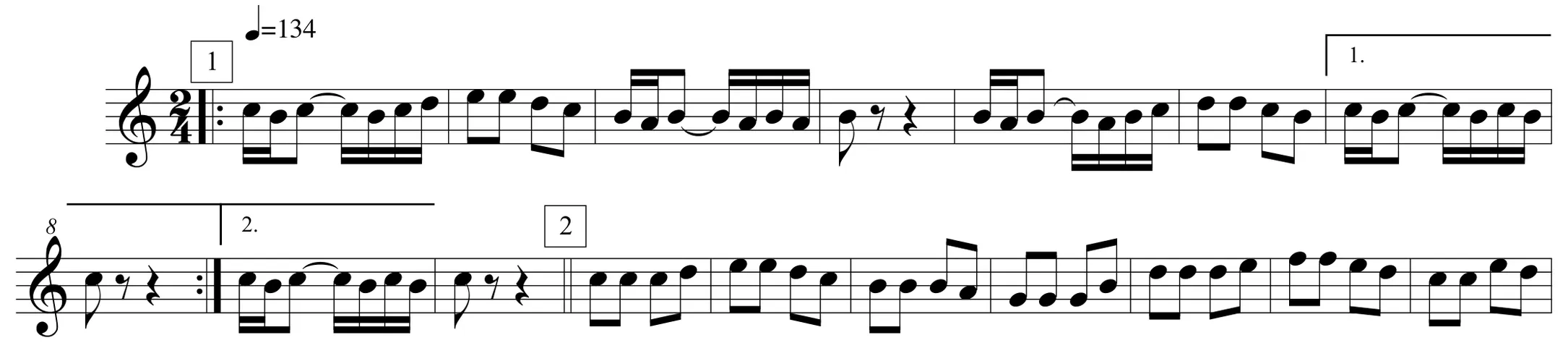
The first and second parts of the musical accompaniment are performed.
Measures 1-4: The dancers perform the “basic movement of the Pleskun dance” (movement No. 22). On the last quarter of the fourth measure, the dancers, in pairs, assume the “Waltz” position (position No. 14), as indicated in the movement description.
Measures 5-8: The couples circle, moving clockwise in a circle using step No. 3 – the Podillia basic step; during the turn in the last quarter of the eighth measure, the partners separate from each other and return to the starting position of this dance figure.
Measures 9-16: The dancers repeat the movements performed in the previous eight measures.
Measures 17-28: The dancers repeat the movements performed in the first part of this dance figure.
Measures 29-32: The young men use Step No. 1 – a simple dance step – to move apart and form a semicircle. The young women use the same movement to form a circle in the center of the stage (Diagram No. 2).
FIGURE TWO. 16 measures
The first part of the musical accompaniment is performed.
Measures 1-4: The young women move clockwise in a circle using movement No. 3 in a turn (“polechka”), on the third measure, while continuing to move in a circle, they perform a “back step” with clapping (movement No. 18a); on the fourth measure: they perform a running step (movement No. 5).
Measures 5-12: The movements from measures 1-4 of this figure are repeated twice.
Measures 13-14: the young women approach their partners with movement No. 1 (simple step).
On measure 15, the young women perform a “back step” with clapping (movement No. 18a).
On measure 16, the young women perform a triple stomp (movement No. 6). At the same time, the young men perform a simple dribble (dribushka) with a tap for measures 1-2 (movement No. 16a).
On measure 3, the young men perform a “step back” with clapping (movement No. 18a). On measure 4, a triple stomp is performed (movement No. 10). Next, on measures 5-16, the movements from measures 1-4 of this figure are repeated three times. At the end of this figure, the dancers line up as shown in diagram No. 3.
Diagram No. 3 Diagram No. 4
FIGURE THREE. 16 measures
The second part of the musical accompaniment is performed.
Measures 1-4: The dancers perform the basic movement of the Pleskun dance
Measure 5-7: Partners join their right arms, bent at the elbows (position No. 15), and circle in place, performing step No. 3 while moving clockwise. Free hands on the waist.
Measure 8: Partners in pairs separate their hands and face each other (diagram No. 3) and perform a triple tap. Hands on the waist.
Measures 9-12: The main dance movement is repeated (movement No. 22).
Measures 13-14: The dancers use step No. 3 to position themselves on stage as shown in diagram No. 4.
Measure 15: The dancers perform “two jetés” backward with clapping (movement No. 18a).
Measure 16: A triple stomp is performed (movement No. 10), with hands on the waist.
FIGURE FOUR. 32 measures
The first and second parts of the musical accompaniment are performed.
Measures 1-2: The dancers move to the right as follows. On “on the off-beat,” the left foot lifts slightly off the floor. On “one” – stomp sharply with the left foot, placing it flat next to the right foot. The arms open into second position. Simultaneously, lift the right leg, bent at the knee; the lift of the right leg is slightly extended. On “and” – take an energetic step to the right and stomp the entire foot on the floor. Simultaneously, lift the left leg off the floor. On “two” – bring the left leg next to the right, stamping down with the entire foot, while simultaneously lifting the right leg, bent at the knee, off the floor. This movement is repeated on the second beat.
Measure 3: perform “two jetés” backward with a clap (movement No. 18a). The arms are lowered and slightly drawn back.
Measure 4: Perform a triple stomp (movement No. 10). Hands on the waist.
Measures 5-8: The dancers perform the movements from measures 1-4, but starting with the opposite foot, moving to the left.
Measures 9-12: Perform a “do-za-do” (movement No. 19).
Measures 13-15: Partners join hands as described in position No. 7 and circle in place clockwise, performing movement No. 3.
Measure 16: a triple stomp is performed (movement No. 10). Hands on the waist.
Measures 17-28: The movements performed on measures 1-12 of this figure are repeated.
Measures 29-31: Assume position No. 10 and form a circle using step No. 3.
Measure 32: the partners release their hands, turning to face each other, and perform a triple stomp (movement No. 10). On the “one” of the last measure – hands on the waist; on the “two” – the partners take turns raising their hands slightly above their heads (diagram No. 5).
Diagram No. 5 Diagram No. 6
FIGURE FIVE. 32 measures
The first and second parts of the musical accompaniment are performed.
Measures 1-2: The dancers move in a circle clockwise. The young women perform movement No. 3 (Podillia alternating step), circling under the young man’s arm while performing a single turn (on the measure 1 they are facing away from the young man, on the 2nd – facing him), while the young men follow the young women using the Podillia alternating step. (Movement No. 3)
Measures 3-4: The movements from measures 1-2 of this figure are repeated, but on the last quarter of the fourth measure, the partners release each other’s hands and lower them down along their sides.
Measures 5-8: The dancers perform a variation of the basic movement of the “Pleskun” dance (movement No. 22a). On the last quarter of measure 8, the dancers return to the position in which they began this figure.
Measures 9-24: The dancers repeat the movements of measures 1–8 of this figure twice.
Measures 25-27: The dancers repeat the movements from measures 1–3 of this figure.
Measure 28: The young women turn to face the young men and perform a triple stomp (movement No. 10).
Measures 29-30: The young men, using movement No. 3 with a step back, form a semicircle facing the audience; at the same time, the young women, performing movement No. 1, move toward the center of the stage and form a circle (diagram No. 6).
Measure 31: The dancers perform “two jetés” backward with clapping (movement No. 18a).
Measure 32: Everyone performs a triple stomp (movement No. 10).
Diagram No. 7 Diagram No. 8
FIGURE SIX. 16 measures.
The first part of the musical accompaniment is played.
Measures 1-4: The young women turn to the right, extend their right arms toward the center of the circle, forming a star. Their left arms are open, palms at hip level (position No. 13), and move in a circle, performing movement No. 3 (diagram No. 7).
Measure 5: The young women turn to face the center of the stage and perform “two jetés” backward with clapping (movement No. 18a).
Measure 6: The young women perform a triple stomp (movement No. 10), with their hands on their waists.
Measure 7: The young women repeat (movement No. 18a).
Measure 8: The young women turn 90° clockwise, perform a triple stomp, forming a star (position No. 13). They extend their left arms toward the center.
Measures 9-16: The young women repeat the movements from measures 1-8 of this figure, but move in a counterclockwise circle (pattern No. 8). At the same time, the young men, on measures 1-4: perform a clap twice (movement No. 23). Measures 5-8: the young men perform a complex dribble (dribushka) (movement No. 166). The hands move as follows during this time: on measures 5-6, the left hand opens from first position to second, and the right hand rests on the waist. On measure 6: the left hand opens from first position to second, the right hand goes to the waist; on measure 7 – both hands open from first position to second, palms facing upward; on measure 8: both hands are brought to the waist. Measures 9-16: The young men repeat the movements they performed in measures 1-8 of this figure.
Diagram No. 9 Diagram No. 10
FIGURE SEVEN. 16 measures
The second part of the musical accompaniment is played.
Measures 1-3: The young women step back, performing movement No. 3, forming a semicircle.
On measure 4, they perform a triple stomp. On measure 1, their arms gradually move to first position; on measure 2, they return to third position; on measure 3, they open out to second position; and on measure 4, they place their hands on their waists. At the same time, the young men, leaning their upper bodies forward, move forward toward the center of the stage, forming a semicircle, and perform movement No. 3. Their arms are lowered and drawn back slightly. On measure 4, the young men, together with the young women, perform a triple stomp (movement No. 10). Arms are at their sides, the torso is straight (diagram No. 9).
Measures 5-6: The young men perform the Podillia squat with a foot tap (movement 216) on the right and left feet. At the same time, the young women perform a simple dribble (dribushka) with a stomp (movement No. 16a, diagram No. 10). The young women's hands are open in second position on measure 5 and on the waist on measure 6.
Measure 7: All dancers perform “two jetés” with clapping (movement No. 18a).
Measure 8: Everyone performs a triple stomp (movement No. 10), hands on the waist.
Measures 9-10: The young men repeat the young women’s movements from measures 1-2 of this figure; at the same time, the young women also approach the young men from the right side using movement No. 3.
Measures 11-16: Partners join hands, palms together (position No. 10), moving in a Podillia alternating step (movement No. 3), and line up in two lines (diagram No. 11)
FIGURE EIGHT. 32 measures
The first and second parts of the musical accompaniment are performed.
Measures 1-4. All dancers perform the movements they did in measures 1-4 of the fourth figure, but the young women begin the movement with their left foot, moving to the left in front of the young men, while the young men begin with their right foot and move to the right behind the young women.
Measures 5-8: These same movements are repeated, but the young women start with their right foot and move to the right, while the young men start with their left foot and move to the left.
Measures 9-12: The young men place their right arms around the young women’s waists; the young women place their left hands, palms down, on the young men’s right shoulders; their free hands are joined, palms together, at hip level. Dancers in pairs circle in place counterclockwise, performing movement No. 3. (diagram No. 12).
Diagram No. 11 Diagram No. 12
Measures 13-14: Partners separate their hands, opening them to second position, and perform a simple dribble with a stomp (movement No. 16a). During the stomp, the dancers place their hands on their waists.
Measure 15: The dancers perform “two jetés” backward with a clap, starting with the right foot.
Measure 16: Everyone performs a triple stomp (movement No. 10), with hands on the waist.
Measures 17-32: The movements performed in measures 1-16 of this figure are repeated.
FIGURE NINE. 32 measures
The first and second parts of the musical accompaniment are performed – the tempo is livelier than in the previous musical accompaniment.
Measures 1-2: The young men and young women change places, performing a turn with a clap (movement No. 24). The young women turn counterclockwise, starting with the left foot; the young men turn clockwise, starting with the right foot. The young women pass in front of the young men (diagram No. 13).
Measures 3-4: The dancers perform a simple dribble (dribushka) with a lean (movement No. 16a)—the arms open from first position to second, then return to the waist.
Measures 5-8: The movements from measures 1-4 are repeated, but the young women turn clockwise, starting with the right foot, while the young men turn counterclockwise, starting with the left foot. At the end of the 8th measure, the partners face each other.
Measures 9-12: The dancers perform the basic movement of the “Pleskun” dance (movement 22); in the last quarter of measure 12, the partners take each other’s right hands (position No. 17).
Measures 13-15: The dancers circle in place clockwise, performing movement No. 3. (One 360° turn is performed.)
Measure 16: The partners release each other’s hands, turn to face the audience, and perform a triple close-up (movement No. 10), with their arms open in second position.
Measures 17-28: The dancers repeat the movements performed in measures 1-12 of this figure (diagram No. 14).
Diagram No. 13 Diagram No. 14
Measures 29-30: The dancers in pairs circle in the same way as in measures 13-15 of this figure, but perform a 360° turn not over three measures of the musical accompaniment, but over two.
Measures 31-32: The partners release each other’s hands, turn to face the audience, and perform a tombé with a heel lift (movement No. 17). Young women start with their right foot; young men, on an off-beat in measure 31, hop onto their right foot and perform movement No. 17 from the left foot. The final pose for young women is with the right arm extended backward in the third lowered position. The left arm is extended forward in the second lowered position. For the young men, it’s the opposite – the left arm is in the third lowered position, and the right is in the second lowered position. They look at each other.
Аудіопрогравач із фонограмою
Прослухайте фонограму танцю. Використовуйте її для навчання або виступів.
Музичний супровід
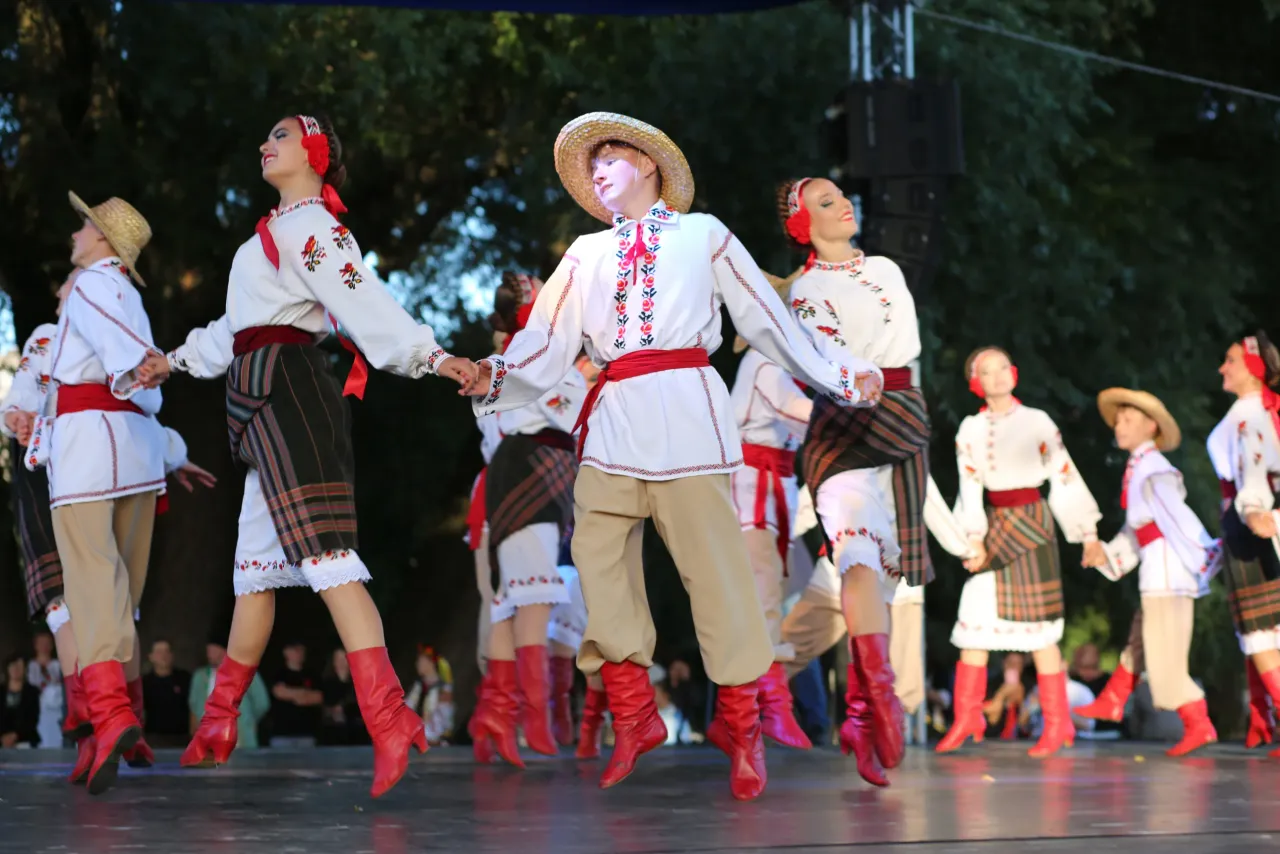
Навчайтеся танцювати разом з нами!
Покрокові відеоуроки допоможуть вам опанувати рухи подільських танців
Перейти до вивчення танцю