
Фонограма танцю
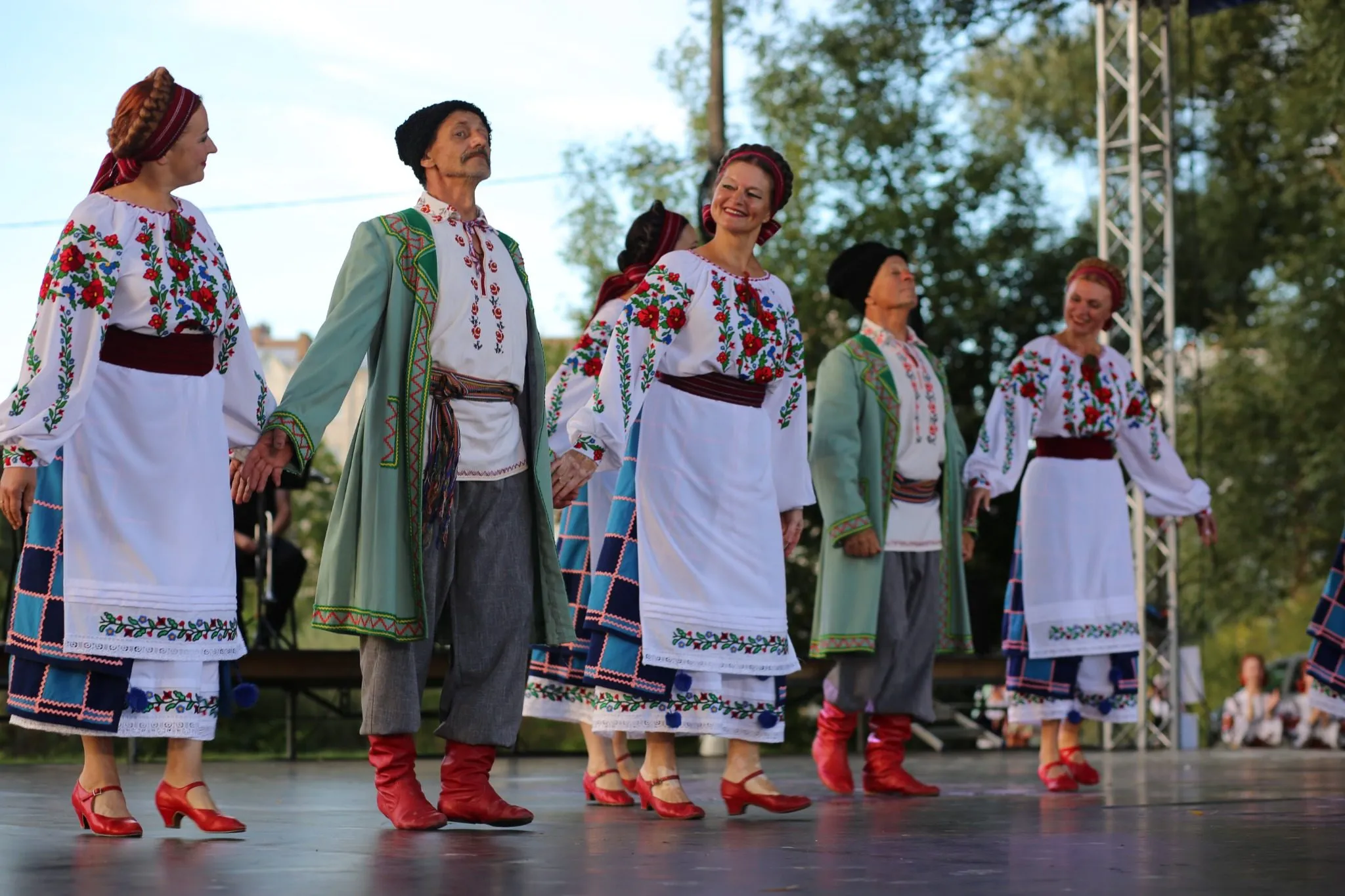
The Podillia Quadrille “Dev’yatka”
- Походження:
- the village of Medzhibizh, Letychiv District, Khmelnytskyi Oblast
- Хореографія:
- Choreography - Oleksandr Nebesny; recreation - Serhiy Pedan, recipient of the “Excellence in Education” award from Ukraine
- Виконує:
- A combined ensemble of former dancers from the “Podillya” and “Gonta” groups and the directors of the folk dance groups “Namysto,” “Podillya,” “Vasilechky,” and “Vesnyanka” in the city of Khmelnytskyi
The dance was recorded in the village of Medzhybizh in the Letychiv District of Khmelnytskyi Oblast. Oleksandr Nebesnyi transformed a traditional, playful folk dance into a spectacular, dynamic stage dance that showcases the dancers’ high level of skill not only in dance but also in acting.
Опис проєкту
DANCE DESCRIPTION: Podillia Quadrille “Dev’yatka”
Choreography - Oleksandr Nebesnyi
Reconstruction - Serhii Pedan, Honored Educator of Ukraine
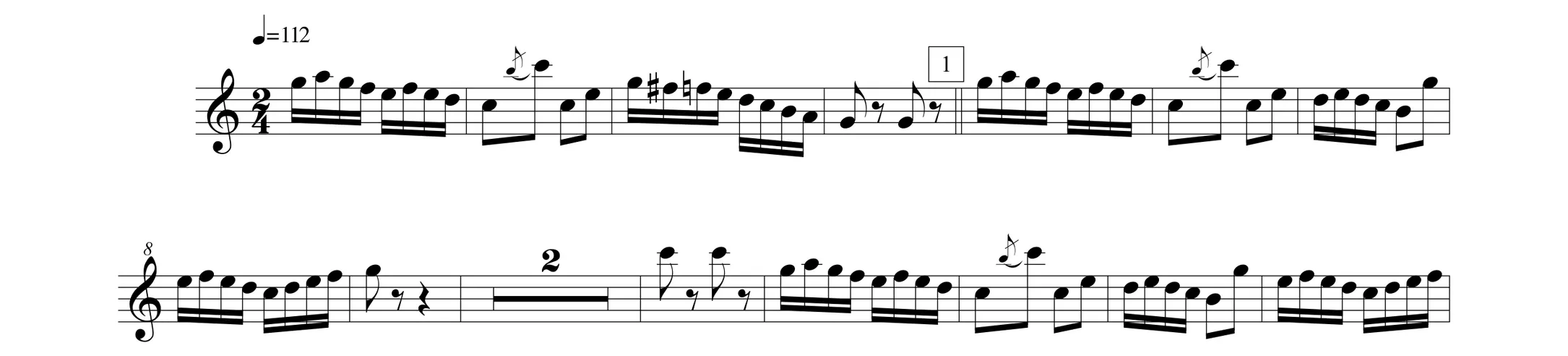
Arrangement - Ihor Pokhodoshchuk
Performance - a combined ensemble of former dancers from the “Podillya” and “Gonta” groups and the directors of the folk dance groups “Namysto,” “Podillya,” “Vasylechky,” and “Vesnianka” from the city of Khmelnytskyi.
Duration - 5:21 min.
History of Creation: The dance was recorded in the village of Medzhybizh, Letychiv District, Khmelnytskyi Region. Oleksandr Nebesnyi transformed a traditional, playful folk dance into a spectacular, dynamic stage dance that showcases the dancers’ high level of skill not only in dance but also in acting.
Description of the Dance:
There are nine performers: three young men and six young women. Each young man has his own character.
Before the dance begins, the first young man is in the third right wing. The second is in the first right wing, and the third is in the first left wing. The girls are in the first left wing.
Four measures of the musical introduction are performed.
First Figure (32 measures)
Measures 1-4. From the third right wing, the first young man moves toward the center of the stage, performing movement No. 5.
Measures 5-8. Musical pause. The young man strikes the floor six times with his right foot. His torso is held upright, his right arm is raised, and his left arm is held alongside his body. After lightly hopping onto his right foot, he stomps with his left foot. He clenches his hands into fists and holds them at his waist.
Measures 9-16. The music plays from the beginning. From both sides, the second and third young men step forward toward each other using the basic step (movement No. 1). Arms are held along the torso. The first young man moves freely.
Measures 17-20. All young men perform a tinok (movement No. 4).
Measures 21-24. The second and third young men move around the first young man using movement No. 5 and line up in a single file. The first young man watches them.
Measures 25-28. The girls enter one after another from the first left wing using the basic step (movement No. 1). Their arms are lowered along their sides and slightly spread apart. The young men step to the right with their right foot, shifting their body weight onto it, without lifting their left foot (heel raised and toes extended) off the floor. Their arms are crossed at the waist, and their gaze is directed toward the girls.
Measures 29-32. The girls continue moving, forming a line, and on measure 32 turn to face the audience (Fig. 1). The boys shift their weight to their left leg, and on measure 32 bring their right leg next to their left.
Second Figure (32 measures)
Measures 1-4. The girls move backward with the basic step and approach the boys. The boys lower their arms along their sides and wait for the girls. The dancers form trios.
Measures 5-6. The trios move backward using the basic step.
Measures 7-8. The central trio continues moving backward, while the side trios move forward. The boys perform their roles, and the girls turn their torsos and heads toward the boys.
Measures 9–16. The trios turn in place: the left trio counterclockwise, the right and center trios clockwise. They stop as shown in Fig. 2.
Measures 17-24. The girls standing to the right of the boys take a basic step toward the center (Fig. 2), move in a small clockwise circle, and return to their places—that is, to the right of the boys, facing the center of the stage. The girls on the left walk around the boys, glancing at them, and return to their places. The boys perform three taps (movement No. 4) starting with the right foot, followed by a stomp with the right foot. Six taps with the right foot, keeping the heel on the floor, followed by a stomp with the right foot and a stomp with the left foot. The body is heldupright, with hands folded at the waist.
Fig. 2
Measures 25-32. The girls perform movement No. 7, turning 90° to the right with each movement (they make two turns). The boys repeat the movements from measures 17–24.
Third Figure (32 measures)
Measures 1-16. All trios move in the basic step, as shown in Fig. 3. The girls standing to the right of the boys move toward the center of the stage, forming a star.
Fig. 3
At the end of the 16th measure, the trios line up in the center of the stage in a column—forming three columns, with the young men in the center (Fig. 4).
The young men continue to portray their characters. The girls glance at the young men to attract their attention. All performers keep their arms lowered at their sides.
Fig. 4
Measures 17-32. The girls move around the boys counterclockwise (Fig. 4); when they meet the boys, they greet them (by curtsying). The boys hop onto their left foot, stamp their right foot, and watch the girls.
Fourth Figure (32 measures)
Measures 1-16. All dancers move in a circle using the basic step: the four outer girls move counterclockwise around the central boy, while the two central girls and the two outer boys move clockwise in a large circle (Fig. 5).
Fig. 5
At the end of the 16th measure, the boys and girls gather in groups of three and line up as shown in Fig. 6.
Measures 17-20. The girls take four basic steps forward on their right foot, then perform movement No. 3 twice. The boys take four basic steps forward on their right foot, with their arms at their sides. Then they tap the floor four times with their right foot, bringing their arms across their waists.
Measures 21-24. The dancers repeat the movements from measures 17–20 while moving backward.
Measures 25-28. The girls in the first line take a basic step backward and to the right; the girls in the third line take a basic step forward and to the left (Fig. 6). The boys take a basic step in place. At the end of measure 24, everyone forms a single line.
Measures 29-32. The outer trios move forward, while the center trio moves backward (Fig. 7). All dancers hold hands along their sides. At the end of the 32nd measure, the girls, without letting go of the boys’ hands, take a step away from their partners and place their other foot in first straight position. They tilt their torsos to the side and look away from the boys. The girls raise their free hands to second position.
Fifth Figure (32 measures)
Measures 1-2. The girls standing on the right turn toward the boy on their left foot, and the girls standing on the left turn on their right foot. As they approach the boys, they lean against them. When turning toward the boys, the boys’ and girls’ joined hands rest loosely on their partners’ waists. The girls wrap their joined hands in front of their torsos, with the palms of their free hands lightly pressed against their opposite shoulders, as if shielding their faces from the boys. The boys remain in place, draw the girls close, and glance from one to the other.
Measures 3-4. The girls turn in opposite directions and return to their original positions. The girls’ eyes are fixed on the boys. The boys glance from one girl to the other. The dancers hold their joined and free hands at second position.
Measures 5-8. The dancers raise their joined hands upward. The girls, starting with their right foot, move in opposite directions in two small circles using an alternating step (movement No. 2): the girls to the right of the boys, maintaining the gate formation, move counterclockwise along the outer circle; the girls on the left slightly lean their upper bodies forward and move in a gate formation along the inner circle clockwise. As they pass the boys, they return to their original positions. The boys remain in place and watch the girls.
Measures 9-12. The participants repeat the movements from measures 1-4.
Measures 13–16. Everyone repeats the movements from measures 5–8. The girls on the left side of the boys move along the outer circle.
Measures 17-24. The side trios use the basic step (movement No. 1) to turn toward the center of the stage and move toward each other, as shown in Fig. 8. The central trio performs a counterclockwise turn in place using the basic step. The dancers’ positions in the trios are the same as at the beginning of the dance.
Measures 25-32. The side trios continue moving backward and turn to face the audience. The central trio moves forward and stops, as shown in Fig. 9.
Fig. 8
Sixth Figure (32 measures)
Measures 1-4. The girls take four basic steps forward, then use an alternating step (movement No. 2) to switch places in front of the boys. The boys perform three taps (movement No. 4), a stomp, six foot taps without lifting their heels off the floor, a stomp with the right foot, and a stomp with the left foot.
Measures 5-8. The girls take four basic steps backward, then use an alternating step to switch places behind the boys. The boys repeat the movements from measures 1-4.
Measures 9-16. The girls move clockwise around the boys, keeping their eyes on the boys. The boys repeat the movements from measures 1–8.
Measures 17-32. All trios begin moving clockwise (Fig. 9) toward the third right wings. The boys continue to flirt, first with one girl, then with another. The girls cast flirtatious glances at the boys.
Fig. 9
Seventh Figure (32 measures)
Perform the four measures of the musical introduction.
Measures 1-8. Entering from the third right wing, the first young man repeats the movements of measures 1-8 of the first figure.
Measures 9-12. The second young man enters from the third right wing, moving in the basic step.
Measures 13-16. The second young man performs a “tynok” (movement No. 4), while the first is surprised to see only one young man.
Measures 17-24. Both young men look for the third.
Measures 25-32. From the third right wing, diagonally (Fig. 10), the third young man enters with the basic step, followed by all the girls with their heads held high, paying no attention to the first two young men. The girls’ arms are lowered along their bodies and slightly turned out to the sides.
Eighth Figure (32 measures)
Measures 1-4. The third young man stops, facing the girls (Fig. 10). The girls continue moving diagonally and, once they are next to the third young man, one turns left and the other turns right, forming a large circle. Surprised, the first and second young men step into the center of this circle.
Measures 5-8. The girls move in a clockwise circle using the basic step, paying no attention to the young men in the center. The third young man watches all the girls from his spot. The first and second young men perform a “tynok” (movement No. 4) three times, a stomp, six foot taps without lifting their heels off the floor, a stomp with the right foot, and a stomp with the left foot. The young men keep their hands on their waists, clenched into fists.
Fig. 10 Measures 9-16. The third young man leads all the girls behind
him into the third right wing. The first and second young men desperately try to turn the girls around, but to no avail. Offended, they walk off to the opposite wings, performing the “tynok” (movement No. 4).
DESCRIPTION OF MOVEMENTS
Movement No. 1. Basic Step
Starting position – feet in the first straight position.
On the “and” beat – rise onto the balls of the left foot. Simultaneously, step forward with the right foot onto the ball of the foot. The knees, instep, and toes are extended but not tense.
On “one” – take a small step forward, lower yourself onto the entire sole of your right foot, slightly squatting and shifting your body weight onto it. At the same time, lift the heel of your left foot off the floor.
On “and” – straighten your right knee and rise onto the balls of your right foot. At the same time, step your left foot forward onto the ball of your foot. Keep your knee, instep, and toes extended but not tense.
On “two” – take a small step forward, lower yourself onto the entire sole of your left foot, slightly squatting and shifting your body weight onto it. At the same time, lift the heel of your right foot off the floor.
On “one” – repeat the movements performed on the “one” count.
The movement is performed in the same way with the left foot.
Movement No. 2. Alternating Step
Starting position – first straight leg position.
On “one” – take a wide, smooth step forward from the toes to the entire foot. The extended left leg remains behind and is shifted to the ball of the foot.
On “and” – take a small, smooth step with the left foot, rolling from the ball of the foot to the entire sole. The extended right leg remains behind and is placed on the ball of the foot.
On “two” – take a small step with the right foot, rolling from the ball of the foot to the entire sole; the extended left leg remains behind and is placed on the ball of the foot.
On “and” – pause.
The movement is performed in the same way from the left foot.
Movement No. 3
Starting position – third position, right foot forward.
On “one” – take a small step to the right with your right foot.
On “and” – rise onto the balls of your right foot. At the same time, bring the left leg forward at a 45° angle, bending the knee; turn the inner side of the foot forward, with the toe extended. Turn the torso so the right shoulder faces forward.
On “two” – lower onto the entire sole of the right foot; the left leg remains in the previous position. Keep your torso turned with your right shoulder forward.
On “and” – pause.
The movement is performed in the same way from the left foot.
Movement No. 4. Tynok
Starting position – third position, right foot forward.
On the off-beat “and” – lift your extended right leg forward and trace a semicircle to the right, simultaneously pushing off the floor with your left leg. Turn your torso to the right
On “one” – place your right foot behind your left, lifting your left foot off the floor.
On “and” – step forward with the left foot on the balls of the toes, placing it in front of the right, and shift your body weight onto it. At the same time, barely lift the right foot off the floor.
On “two” – bring the right foot up to the left in third position behind, shifting your body weight onto it. At the same time, slightly lift the left foot off the floor.
On “and” – repeat the movements performed on the “and” count.
The movement is performed in the same way starting from the left foot.
Movement No. 5. Running
Starting position – first straight leg position.
On “one” – jump slightly onto your right leg, bend your left knee, and lift it backward.
On “two” – jump onto your left leg, bend your right knee, and lift it backward.
Repeat the movement.
Movement No. 6. Running Start
Starting position – first straight leg position.
On “one-and” – lightly jump onto the right leg, lunging forward.
On “two-and” – lightly jump onto the left leg, lunging forward.
The movement is performed in the same way from the other leg.
Movement No. 7. Podil Step
Starting position – first straight leg position.
On the off-beat “and” – slightly squat on the left leg. Raise the right leg, bent at the knee, to shin level, with the knee pointing forward and the toe extended.
On “one” – place the right foot on the floor on the balls of the toes.
On “and” – step forward on the balls of the left foot.
On “two” – step onto the entire sole of your right foot and slightly squat on it. Lift your right leg, bent at the knee, to shin level, with the knee pointing forward and the toe extended.
On “and” – pause.
The movement is performed in the same way starting with the left leg.
Аудіопрогравач із фонограмою
Прослухайте фонограму танцю. Використовуйте її для навчання або виступів.
Музичний супровід
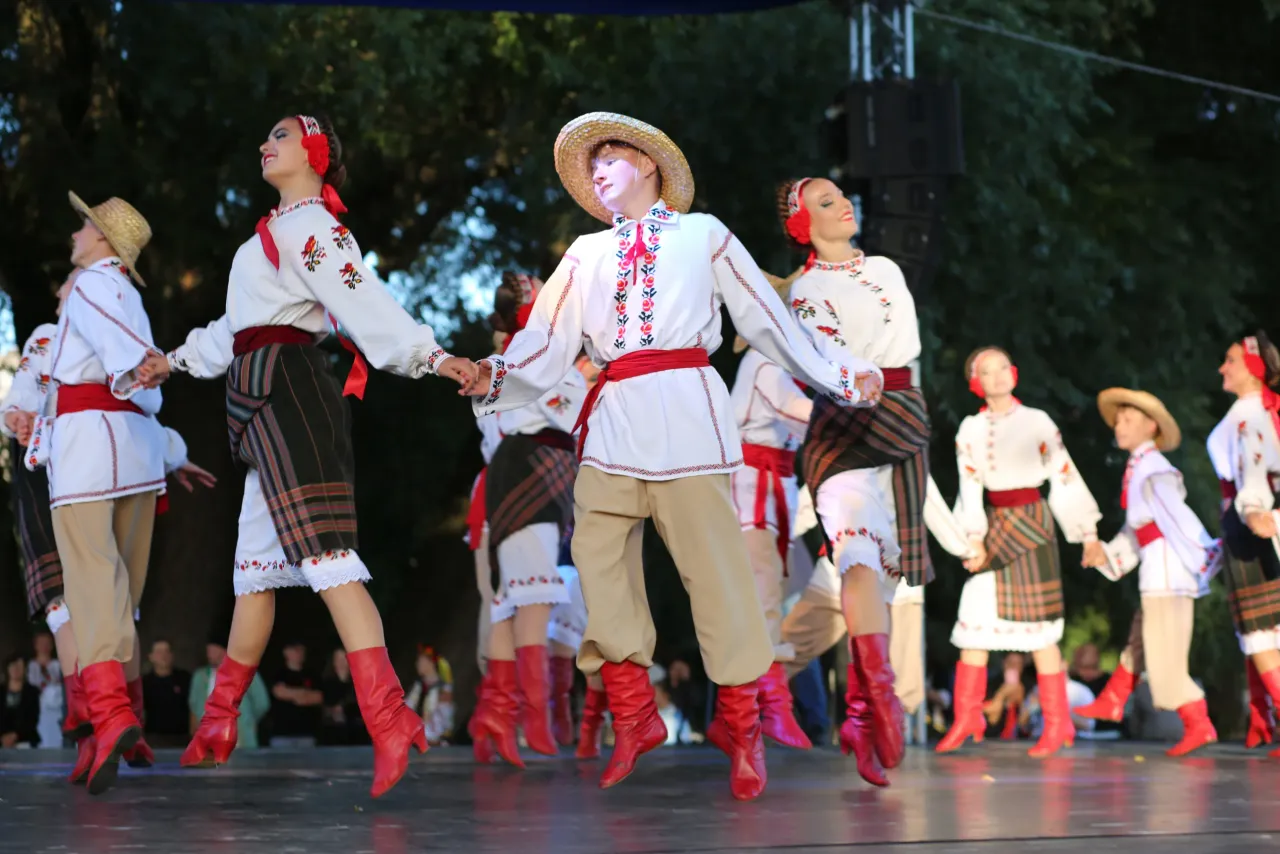
Навчайтеся танцювати разом з нами!
Покрокові відеоуроки допоможуть вам опанувати рухи подільських танців
Перейти до вивчення танцю