
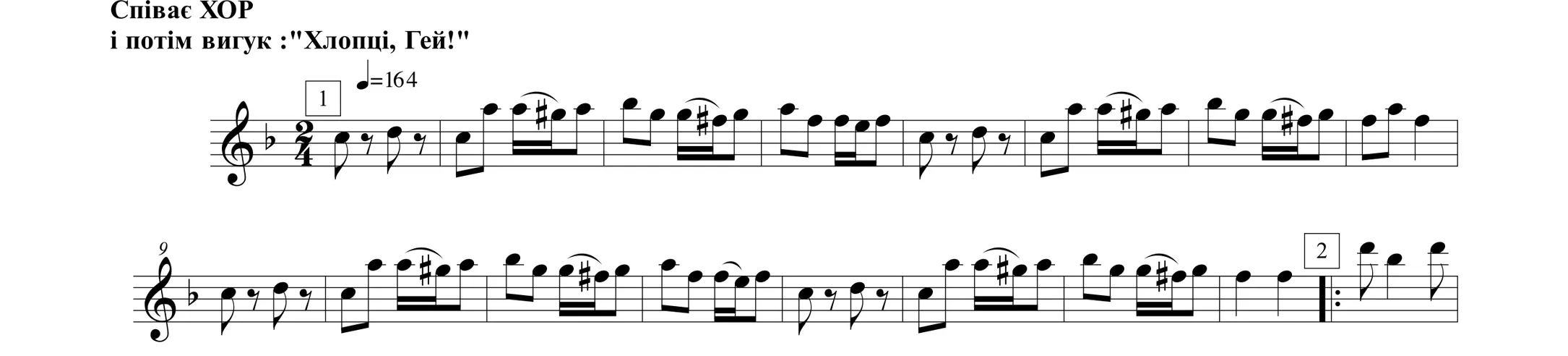
Фонограма танцю
Podil Festivities
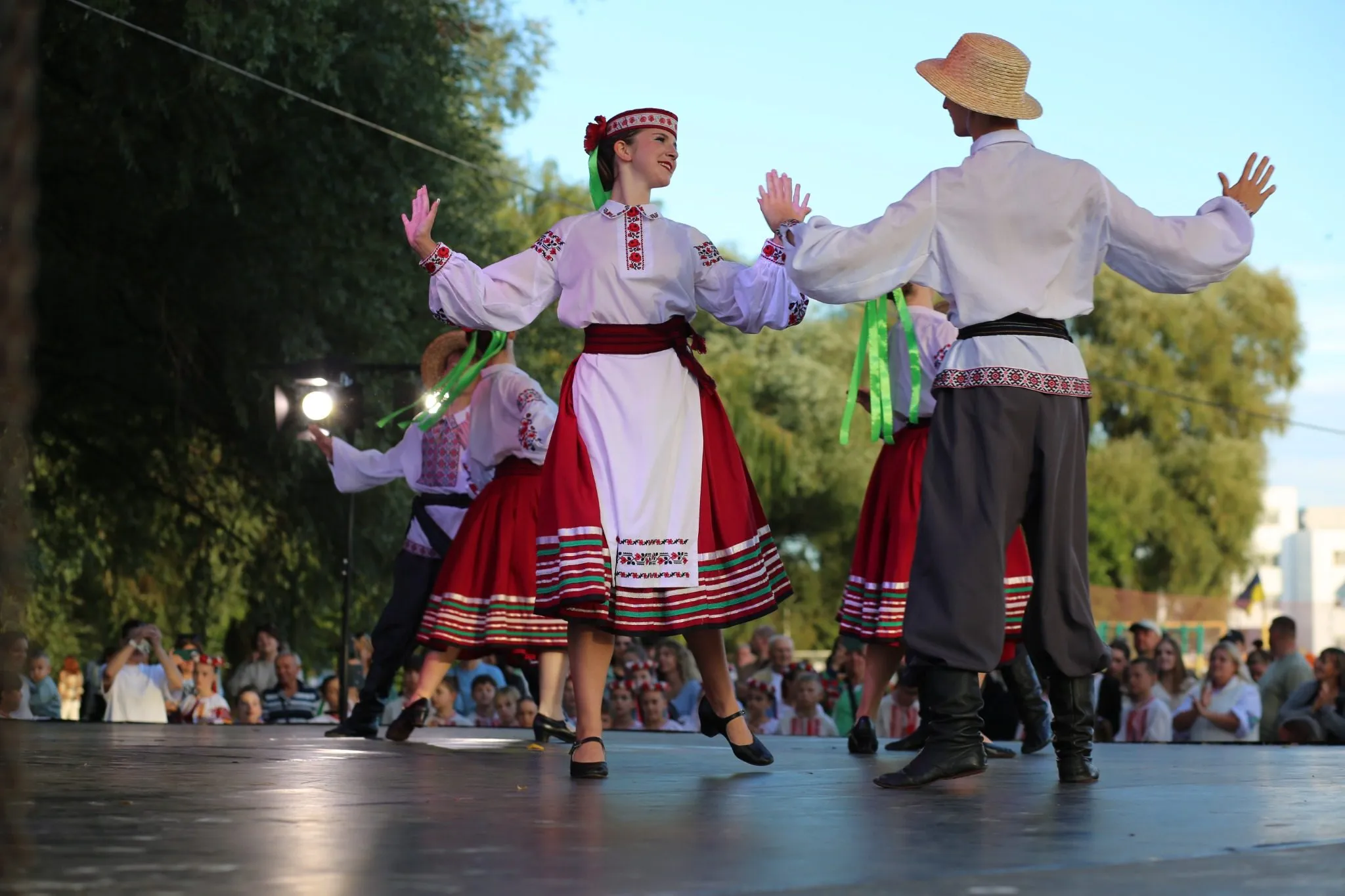
- Походження:
- Tarasivka Village, Kamianets-Podilskyi District, Khmelnytskyi Oblast
- Хореографія:
- Direction – Oleksandr Nebesnyi Restoration – Serhiy Pedan, recipient of Ukraine’s Excellence in Education Award Arrangement – Ihor Pokhodoshchuk
- Виконує:
- The “Barvinok” Folk Dance Ensemble of the Borshchahivka School of Arts (Sofiivska Borshchahivka village, Bucha District, Kyiv Oblast), directed by Olena and Volodymyr Dolchuk.
This dance is one of Oleksandr Nebesnyi's earliest choreographic works within the program of Podillia folk-stage dances for the "Podillia" Folklore and Ethnographic Dance Ensemble, founded in 1975. The composition is based on songs and material from three traditional Podillia dances recorded in the village of Bakota, Staroushytsia (now Kamianets-Podilskyi) District: "Varvarka," "Oliandra" (which was popular in the southwestern part of Podillia), and the Podillian polka. The dances "Varvarka" and "Oliandra" were recorded from members of Khmelnytskyi region's first amateur folklore ensemble "Varvarka" from the village of Bakota, which was established in 1937 on the initiative of the local collective farm chairman and Deputy of the Verkhovna Rada of Ukraine, Mariia Oleksiivna Solomko, and Village Council Chairman Yarema Fedorovych Oliinyk. The ensemble's permanent director and accompanist was Yukhym Andriiovych Varvaruk, a clarinetist renowned throughout the entire region.
In 1969, People's Artist of Ukraine A, M. Kryvokhyzha created a choreographic arrangement based on these dances, which were shown to him by Vitalii Kents, a graduate of the Bakota Eight-Year School, native of the neighboring village of Teremtsi, and at that time a student and member of the "Horlytsia" dance ensemble at the Kamianets-Podilskyi State Pedagogical Institute. The dance consisted of four parts with an introduction and a coda. The storyline of the dance was based on the humorous Podilian folk song "Po toku, po toku..." (On the Threshing Floor...), the dance "Oliandra," and the Podilian polka "Prosta" (Simple), and the composition was named "Varvarka."
Later, in 1972, Volodymyr Siedin, director of the "Horlytsia" ensemble, created his own choreographic composition "Varvarka" using material recorded in the villages of Bakota, Teremtsi, and Kolodiivka, as well as musical material collected by Oleksii Davydovych Bets, a native of those places. It was performed with the participation of a folk instruments ensemble and its permanent member, dancer and musician M. Symbrat.
In 1975, with the support of Volodymyr Siedin, Oleksandr Nebesnyi created the production "Podilianski hulianochky" (Podilian Festivities) for his own company—the "Podillia" Folklore and Ethnographic Dance Ensemble.
Опис проєкту
DANCE DESCRIPTION: “Podilski Hulianochky” ("Podillia Festivities")
[Танець «ПОДІЛЬСЬКІ ГУЛЯНОЧКИ»]
There are eight couples performing. The number of participants can be increased by an even number.
Before the dance begins, all the young women stand on the left side of the stage, and the young men on the right.
The musical introduction begins.
As the music starts, the young men and women come out to “guliannia" (hanging out) and notice one another. The young men bow, removing their hats. The young women bow in response, pressing their right hand against their chest with their palm. The performers form two lines along the side wings.
DESCRIPTION OF THE DANCE
First Figure (48 measures)
Measures 1-8. The first lines of young women and young men perform the standard run (movement No. 2) twice, simultaneously bringing their arms through the preparatory position and clasping them at the waist. They then move to the opposite side using simple dance steps. The second line of young women remains in place and, simultaneously with the first line, brings their hands to their waists. The young men in the second line remain in place and extend their right arms to the third position and their left arms to the second.
Measures 9-12. The young women and young men circle in pairs clockwise using simple dance steps (two turns). The young man holds the young woman’s waist on the left side with his right hand and her right elbow at second position with his left hand. The young woman places her right hand on the young man’s left shoulder and her left hand below his right shoulder.
Measures 13-16. All dancers gather in the center of the stage with a gliding step (movement No. 1) and form two circles, as shown in Fig. 1. The girls hold their arms at their sides, and the boys hold them in second position.
Measures 17-20. All the dancers, facing each other, perform the “tynok” (movement No. 3) twice, starting with the right foot, with their hands clasped at the waist. Then they perform a lunge (movement No. 4) to the right and to the left, as if the young men won’t let the young women leave the circle. The dancers then open their arms into second position.
Measures 21-22. The young men perform movement No. 5 starting with their right foot; they place their right hand on their waist and raise their left hand to third position. While performing the stomp, they bring their left hand to their waist. The girls run out between the young men.
Measures 23-24. The young men perform a squat-kick (movement No. 6) starting from their right foot, with their backs to the center of the circle. The young women spin in place (two turns to the right). They hold their right hand in first position and their left hand in second position. At the end of the 24th measure, the young women turn to face the young men.
Measures 25-28. The young men and women spin in pairs on the spot counterclockwise. As they do so, the young man holds the young woman’s right hand (in front) at second position with his right hand, while his left hand is placed around her waist. The young woman places her left hand on the young man’s right shoulder. At the end of the 26th measure, the dancers step off onto their left foot, bend their right knee slightly backward, and turn to face each other.
Measures29-32. All couples repeat the turn they performed in measures 9–12. At the end of measure 32, all dancers stop, as shown in Fig. 2.
Measures 33-40. All couples repeat the turn they performed in measures 9–12. At the end of measure 32, all dancers stop, as shown in Fig. 2.
On each measure, the dancers, in pairs, perform a two-foot hop, moving toward the center, with their arms crossed at the waist. They then continue the movement with a gliding step (movement No. 1), as shown in Fig. 2.
Measures 41–44. All dancers step forward in simple steps to form two lines. The young men stay slightly behind the young women (Fig. 3).
44-48. Everyone performs a run (movement No. 2) together, opening their arms below second position. At the end of measure, they stomp with their right foot. The young women place their hands on their waists. The young men extend their right arms to third position and their left arms to second position. Their torsos are upright, and their gaze is directed toward the audience.
Musical interlude.
Second figure (36 measures). Varvarka
The lead young man calls out:
Hey, don’t stop us from moving freely!
Play the dances from Bakota—we’ll be dancing!
On the second line, all performers lower their arms to their sides; the girls take a small step back and stand next to the boys.
Four measures of the musical introduction are played, during which the dancers perform the following movements:
Measures 1-2. Holding hands in pairs, all dancers take two alternating steps (movement No. 7) backward.
Measures 3-4. The pairs continue moving backward and take three simple steps, then stomp with the left foot.
Musical pause.
The lead young man calls out: “Varvarka!”
The music for the main section plays.
Measures 1-4. The couples perform an alternating step (movement No. 7) twice, moving forward (the young women start with their right foot, the young men with their left). The young woman’s right hand is held in the young man’s left hand at first position; her left hand rests on the young man’s shoulder, and the young man’s right hand rests on the young woman’s waist. The torso and head are turned toward the audience. Then two simple dance steps. On the first beat of the 4th measure—a stomp (young women with the right foot, young men with the left)—they look at each other.
Measures 5-8. Without changing their position as a couple, the dancers perform two Podillia steps (movement No. 13 in 2/4 time), turning 360°. On the 7th measure, the young men perform a stomp and place their left hand on their waist, while the young women extend their right hand to second position. On the 8th measure, the girls perform a stomp and place their right hand on their waist.
Measures 9-12. The couples repeat the movements of measures 1–4 starting on the right foot, moving backward (facing the audience). The young woman's left hand rests on the young man's shoulder, and the young man holds the young woman by the waist with his right hand. Free hands rest on the waist. During the stomp, the dancers look at each other.
Measures 13-16. The young women move to the left in simple steps, circling around the young men. They keep their hands on their waists and sway their shoulders as they move. The young men perform a step-over (movement No. 8) starting with the right foot, then the left.
Measures 17–20. The young women, in two lines, move forward. They perform six simple dance steps, followed by a stomp. As they move, they sway their shoulders, keep their hands on their waists, and look toward the audience. The boys perform side steps (movement No. 9) forward, then backward.
Measures 21–24. The young women perform movement No. 10 twice, with their hands on their waists. Then they cross their right foot (movement No. 8), turning their upper bodies to the right so they face the audience. The young men perform side steps (movement No. 9) to the right, then to the left.
Measures 25-32. The young women move across the square as shown in Fig. 4 (taking four dance steps each). The young men perform side steps (movement No. 9) forward and backward, then take eight dance steps forward and approach their partners. They hold their hands, clenched into fists, at their waists. At the end of the 32nd measure, the young men and women of each pair turn to face each other.
Third figure (48 measures)
Measures 1-4. All dancers perform a “dribushka” (dribble) (movement No. 11). On the third dribble, the dancers turn to the left – that is, they turn to face a different partner – and stomp their feet. While stomping, they place their hands on their waists and bow.
Measures 5-8. All dancers repeat the movements from measures 1-4, turning to face their partners.
Measures 9-12. The young women perform the step-over (movement No. 8) starting with their left foot, and the young men with their right. During the movement, the young men and women change places. The young women pass under the young men’s right arms, which are linked with their left arms; their free hands rest on their waists. Next, they perform two small dribbles (movement No. 11), turning 360º (girls to the left, boys to the right). They place their hands on their waists.
Measures 13-16. All dancers move apart using simple dance steps toward the side wings, as shown in Fig. 5 (the lines split in half). The young men extend their arms to second position.
Measures 17-20. The young women move toward each other (toward the center of the stage) and take six simple dance steps, tapping their feet. As they move, they sway their shoulders, keep their hands on their waists, and look straight ahead. The young men take side steps (movement No. 9) forward and backward, keeping their hands on their waists and their gaze directed at the young women.
Measures 21-24. After meeting with their right shoulders, the young women strut in front of one another and move in small circles using simple steps. The young men perform side steps to the right and left.
Measures 2-–28. The young women continue moving to the opposite side. The young men perform side steps forward and backward. At the end of the 28th measure, the young women come up to the young men.
Measures 29-32. The young women and young men circle in pairs clockwise using simple dance steps (two turns). The young man holds the girl’s waist on the left side with his right hand and her right elbow at second position with his left hand. The girl places her right hand on the young man’s left shoulder and her left hand below his right shoulder.
Measures 33-36. The young men repeat the movements performed by the young women in measures 17–20. Their arms are lowered and pressed against their bodies; during the stomp, they clasp their hands at the waist. The young women perform movement No. 12 starting with the right foot, keeping their hands on their waists, their gaze directed at the young men.
Measures 37-40. The young men repeat the movements the young women performed in measures 21–24. Their hands are clasped at the waist. The young women perform movement No. 12 starting with the left foot.
Measures 4-44. The young men repeat the movements the young women performed in measures 25–28. Their arms are lowered and pressed against their bodies. The young women perform movement No. 12 starting on the right foot.
Measures 45-48. The couples repeat the movements from measures 29–32. At the end of measure 48, all dancers form a single line near the side wings.
Musical pause.
Fourth Figure (24 measures). “Oljandra”
The lead young man calls out:
Oh, play when you play, when you have a black mustache!
Just change the music and start “Oljandra”!
Four measures of the musical introduction are played, during which the dancers perform the following movements:
Measures 1-4. All dancers, in pairs (the young man holds the young woman's left hand with his right hand), perform three Podillia steps (movement No. 13) starting with the right foot and form a circle (Fig. 1). On the 4th measure, the dancers perform a stomp and turn to face each other (the young women with their backs to the center of the stage). The young man holds the young woman’s waist on the left side with his right hand and her right hand at second position with his left hand. The young woman places her left hand on the young man’s right shoulder.
The music for the main section plays.
Measures 1-4. The dancers, in pairs, perform movement No. 14 along the circle. The young men start with their right foot; the young women start with their left.
Measures 5-8. The pairs repeat movement No. 14 in the opposite direction.
Measure 9. In pairs, the dancers perform movement No. 15 starting with the right foot, turning 360º counterclockwise. They keep their upper bodies straight, and the position of their arms remains unchanged.
Measure 10.. Dancers in pairs jump onto their right foot, slightly squatting on it, and perform two taps with their left foot.
Measures 11-12. Pairs repeat the movements from measures 9–10 starting on the left foot, turning 360º in the opposite direction.
Measures 13-16. Remaining facing each other (Fig. 1), the young men and women release their hands and perform a lunge (movement No. 4 in 3/4 time) to the right, touching each other with their left hands. They then repeat the lunge to the left, touching each other with their right hands.
Measures 17-20. All couples line up in two lines (Fig. 6), performing the Podillia step (movement No. 13) starting with the right foot. The torso is held upright; the young man holds the young woman's left hand with his right hand, and their free hands rest along their sides. At the end of the 20th measure, the dancers perform a stomp and assume the paired position as at the end of the 4th measure of the introduction to the “Oljandra” section, directing their gaze toward the audience.
Fifth Figure (20 measures)
Measures 1-4. All couples perform movement No. 14 (measures 1–3). The young men start on their left foot; the young women start on their right. On the 4th measure, the young men hop onto their left foot (the young women onto their right). Without changing their position as a couple, they tap with their right (left) foot in third position in front. The dancers turn their torso and head toward the audience.
Measures 5-8. The dancers perform movement No. 16. Their positions in the pair remain unchanged, and they look at each other. On the 8th measure, they perform a stomp (young men with the left foot, young women with the right).
Measures 9-10. The young women perform movement No. 15 from the right foot, turning 360° to the right, then jump onto the right foot, slightly crouching on it, and perform two stomps with the left foot. The torso is held upright, and the arms, clenched into fists, rest on the waist. At the same time, the young men, standing slightly behind the young women as shown in Fig. 3, perform movement No. 17 starting on the right foot.
Measures 11-12. The dancers repeat the movements from measures 9–10 starting on the left foot. The young women perform a 360º turn to the left. At the end of measures 12, the young men are positioned to the left of the young women.
Measures 13-14. The dancers perform a lunge (movement No. 4) to the right, touching each other with their left hands. Then – to the left, touching each other with their right hands.
Measures 15-16. The young women repeat the movements from measures 9–10. The young men perform the same movements as the young women.
Measures 17-20. The young women perform movement No. 15, moving forward and forming a circle (Fig. 7). At the end of the 20th measure, they perform a stomp. The young men perform a lunge (movement No. 4), stepping backward. As they do so, they clap their hands on the second and third beats of the measure. On the 20th measure, the young men bring their right foot next to their left and clasp their hands at their waists.
Sixth Figure (20 measures)
Measures 1-8. The young women, performing an alternating step (movement No. 7), move in a circle (Fig. 7) and pass each other alternately with their right and left shoulders. They hold their arms along their sides. The young men perform a lunge (movement No. 4) to the right. They look to the right, then to the left, with their hands on their waists. On measures 7–8, the young men perform a two-foot hop to second position, followed by a regular run, turning 360° to the right, and a tap with the left foot.
Measures 9-16. The young women continue the movement as shown in Fig. 8, with their hands clasped at the waist. The young men repeat the movements from measures 1–4 for four measures. For four measures, they perform the Podillia step (movement No. 13) forward, lowering their arms along their sides. At the end of the 16th measure, the young women approach the young men. All couples form two lines, with the young men positioned slightly behind the young women, as shown in Fig. 3.
Measures 17-18. The young women perform movement No. 15 starting on the right foot, turning 360° to the left, then jump onto the right foot, slightly squatting on it, and tap the floor twice with the left foot. The young men perform the same movements starting on the left foot, turning to the left. The torso is held straight, hands on the waist.
Measures 19-20. The dancers repeat the movements from measures 17-18, turning in the opposite direction. The torso and arms remain in the previous position.
Musical pause.
Seventh figure (32 measures). Polka
The lead young man calls out:
Hey-hop, little boots, tap your heels!
Let them see how the people of Podillia dance the polka!
On the second line, all performers lower their arms alongside their bodies; the young women take a small step back and stand next to the young men.
The music plays.
Measures 1-4. The dancers in each line join their arms, bent at the elbows, and hold them at second position. All dancers take four simple steps (one per quarter beat), moving to the right, then perform movement No. 18 twice, starting with the right foot.
Measures 5-8. The dancers repeat the movements of measures 1-4, moving forward, without changing the position of their arms. On measures 7–8, the young women use a Podillia step (movement No. 13 in 2/4 time) to move to the left side of their partners. The young man holds the young woman's right hand with his left hand.
Measures 9-10. The young women take simple steps starting with the right foot to pass under the young man's left arm to his right side, with their free hand held along their body. The young men move to the left side with simple steps starting with the right foot, with their free hand in second position.
Measures 11-12. All dancers repeat the movements from measures 9-10.
Measures 13-14. The young women and young men circle in pairs clockwise using simple dance steps (half-turns). The young man holds the young woman by the waist on her left side with his right hand and by the elbow of her right arm at second position with his left hand. The young woman places her right hand on the young man’s left shoulder and her left hand below his right shoulder.
Measures 15-16. The dancers, performing the Podillia step (movement No. 13 in 2/4 time), do a “do-za-do.” The torso is held upright, and the arms are crossed at the waist. At the end of the 16th measure, the young women remain to the right and slightly ahead of the young men.
Measures 17-18. The young women spin around their own axes, performing the Podillia step (movement No. 13 in 2/4 time). The young men perform a hop onto their left foot, followed by a stomp with the right foot. They extend their right arm to third position and their left arm to second position. Their gaze is directed toward the young women.
Measures 19-20. The young women continue to turn; at the end of the 20th measure, they stop facing their partners. The young men perform a regular run (movement No. 2), with their arms crossed over their waists.
Measures 21-24. All dancers circle in pairs, holding each other’s right hands, and perform a regular run (movement No. 2). They place their free hands on their waists.
Measures 25-32. The couples perform a polka in a turn (movement No. 19), moving forward as shown in Fig. 9. The young man holds the young woman’s waist with his right hand and her right hand with his left. The young woman places her left hand on the young man’s right shoulder.
Eighth Figure (32 measures)
Measures 1-8. The couples form two circles (two couples each in the first and second lines) and move counterclockwise (Fig. 10), performing a regular run (movement No. 2) and holding hands as at the beginning of the “Polka.” At the end of the 8th measure, all dancers, with their arms hanging down at their sides, turn with their backs to the center of the circle.
Measures 9-16. All couples continue moving with their backs to the center of the circle, raising their joined hands as in the previous measures. At the end of the 16th measure, the couples form two lines, with partners facing each other, as shown in Fig. 9.
Measures 17-24. Holding hands at second position, the dancers perform movement No. 18 four times, starting with the right foot, followed by one turn as a couple in simple steps clockwise.
Measures 25-32. All couples repeat the movements from measures 17-24. At the end of measure 32, the two central couples in the first line remain in place facing the audience, while the remaining couples form a large semicircle (Fig. 11). The young women stand to the right of the young men.
Ninth Figure (32 measures)
Measures 1-4. The two pairs in front, holding hands along their sides, take four simple steps forward. They turn to face each other and, holding hands at second position, perform movement No. 18 twice, starting
with the right foot. The young men and women, forming a large semicircle, join hands with their arms bent at the elbows and perform movement No. 12 starting with the right foot.
Measures 5-8. The pairs in front perform a “do-za-do,” executing the Podillia step (movement No. 13 at in 2/4 time) starting with the right foot. The young men keep their hands on their waists, and the young women hold their hands along their sides. The couples in the semicircle repeat movement No. 12 starting with the left foot. The position of the torso and arms remains unchanged.
Measures 9-12. The young men in the front perform movement No. 18 four times, starting on the right foot and looking at their partners, with their hands clasped at the waist. The young women walk around the young men on the right side with simple steps, placing their hands on their waists. The couples in the semicircle repeat movement No. 12 starting with the right foot.
Measures 13-16. The two pairs in front, holding hands, take four simple steps forward. Then they perform movement No. 18 starting with the right foot and a regular run (movement No. 2); as they move backward, they lower their arms along their sides. The pairs in the semicircle repeat movement No. 12 starting with the right foot.
Measures 17-32. All couples repeat the movements performed by the two couples in front during measures 1-16 (for the first two beats, they line up in two lines). At the end of beat 32, all dancers turn to the left, facing the center of the stage.
Tenth Figure (32 measures). Finale
Measures 1-8. All dancers form a large circle and move counterclockwise (Fig. 12), performing a regular run (movement No. 2) and holding hands as at the beginning “Polka.”At the end of the 8th measure, all dancers, with their arms lowered along their sides, turn with their backs to the center of the circle.
Measures 9-16. All dancers, continuing to move with their backs to the center of the circle, raise their joined hands as in the previous measures.
Measures 17-32. The dancers proceed in pairs to the wings (Fig. 12). The first two pairs perform the Podillia step (movement No. 13 in 2/4 time). Their right hands are clasped, and their free hands rest on their waists. As they move, the young women turn under the young men’s right arms. The second two pairs perform the “tynok” (movement No. 3), moving along the line shown in the figure. Their hands are free. The third two pairs, joining hands as at the beginning of the “Polka,” perform movement No. 12, moving forward along the line shown in the figure 12. The last two pairs repeat the movements performed by the third pairs in the opposite direction.
DESCRIPTION OF MOVEMENTS
Movement No. 1. Zaliotnyi (Flirting Run)
Starting position – first straight leg position.
On “one-and” – lightly hop onto the right foot, gliding forward.
On “two-and” – lightly hop onto the left foot, gliding forward.
The movement is performed in the same way from the other foot.
Movement No. 2. Run
Starting position – feet in the first straight position.
On “one-and” – jump onto left foot, bend the right knee, and bring it slightly back.
On “two-and” – jump onto left foot, bend right knee, and bring it slightly back.
Repeat the movements.
Movement No. 3. Tynok
Starting position: third position, right leg forward.
On the downbeat “one” – lift your extended right leg forward and trace a semicircle to the right, simultaneously pushing off the floor with your left leg.
On “one” – place your right foot slightly behind your left, and lift your left foot off the floor.
On “and” – step forward with the left foot on the balls of your toes, placing it in front of the right, and shift your body weight onto it. At the same time, lift your right foot slightly off the floor.
On “two” – bring your right foot next to your left in third position behind, shifting your body weight onto it. At the same time, lift your left foot slightly off the floor.
On “and” – repeat the movements performed on the “and” beat starting from the left foot.
The movement is performed in the same way starting from the left foot.
Movement No. 4. Lunge
Starting position – third foot position, right foot forward.
On “one-and” – take a large step to the right with the right foot, shifting body weight onto it. The left foot is lifted, with toes pointed. Turn the left shoulder forward.
On “two-and” – push off slightly with the right foot without lifting it off the floor, and shift body weight to the left foot. The right foot is raised, and the toes are pointed. Turn the right shoulder forward.
Perform the same movement with the other foot.
Movement No. 5
Starting position – third foot position, right foot forward.
Measure 1. On “one-and” – step forward with the right foot; press the left foot against the right shin, with the knee pointing to the left, the instep raised, and the toes extended.
On “two-and” – jump slightly on the right foot and turn 180° to the right; the left foot remains in position.
Measure 2. On “one-and” – jump to the left foot, lift the right foot next to the left, with the knee pointing forward.
On “two-and” – tap the floor with the right foot.
The movement is performed in the same way from the left foot to the left.
Movement No. 6. Squat-kick (prysiadka)
Starting position – first position of the feet.
Measure 1. On “one-and” – from a barely noticeable hop, squat sharply and deeply onto the low balls of both feet in first position. Knees are spread to the sides, heels together, toes apart. The torso is held upright.
On “two-and” – using a springy movement of both legs, rise from the deep squat onto the entire sole of the left foot, slightly lowering yourself and shifting your body weight onto it. At the same time, step your right leg forward at a 45º angle, bending the knee, turn the inside of the foot forward, and extend the toe.
Measure 2. On “one-and” – jump onto your right leg, straightening your torso to full height.
On “two-and” – tap the floor with your left foot.
The movement is performed in the same way from the other leg.
Movement No. 7. Alternating Step
Starting position – first straight leg position.
On “one” – step forward with the right foot.
On “and” – take a small step forward with the left foot.
On “two” – take a small step forward with the right foot.
On “and” – pause.
Repeat the movement with the left leg.
Movement No. 8. Step-over
Starting position – third foot position, right foot forward.
Measure 1. On “one-and” – step with the right foot to the right.
On “two-and” – place the left foot on the balls of the toes behind the right foot.
Measure 2. On “one-and” – step to the right with the right foot.
On “two-and” – lift the left foot off the floor, bring the foot back, and place it on the heel to the left.
The movement is performed in the same way starting with the left foot.
Movement No. 9. Side Steps
Starting position – first straight leg position.
On the “and” count – slightly squat on the left leg, lifting the right leg off the floor.
Measure 1. On “one-and-two” – step forward with the right foot, lifting the heel of the left foot off the floor.
On “and” – slightly squat on the right leg, lifting the left leg off the floor.
Measure 2. On “one” – bring the left foot next to the right.
On “and-two” – pause.
On “and” – slightly squat on the right leg, lifting the left leg off the floor.
The movement is performed by stepping back with the left leg.
The movement is performed in the same way to the right and to the left.
Movement No. 10
Starting position: third position, right foot forward.
On “one” – take a small hop to the right on the ball of the right foot, with the right knee extended. Turn the torso so that the right shoulder faces forward. Hands are folded in front of the chest (at the waist).
On “and” – place the left foot on the ball in third position behind the right foot. The torso remains in the previous position.
On “two” – step onto the entire sole of the right foot, squatting slightly on it, and lift the left foot off the floor.
On “and” – strike the floor with the heel of the left foot next to the right and immediately lift it off the floor.
Perform the same movement with the left foot.
Movement No. 11. Dribbles (Dribushki)
Starting position – first straight leg position.
On “one” – jump from the right foot to the left, lifting the right foot off the floor. Extend the right arm to second position, the left to first; the palms are cupped into fists but not clenched.
On “and” – tap the floor with the entire sole of the right foot and immediately lift it off the floor.
On “two” – jump on your left leg, lifting your right leg off the floor. The position of your arms remains unchanged.
On “and” – tap the floor with the entire sole of your right foot and immediately lift it off the floor.
Perform the same movement with the other leg.
Movement No. 12
Starting position – feet in the first straight position.
Measure 1. On “one” – take a small step to the right with your right foot.
On “and” – rise onto the balls of your right foot. At the same time, bring your left leg forward at a 45º angle, bending it at the knee, with the inside of the foot turned forward and the toe extended. Turn your torso so that your right shoulder faces forward.
On “two” – lower your right foot to the full sole.
On “and” – pause.
Measure 2. Repeat the movements of the 1st measure on the left foot.
Measure 3. On “one-and” – take a small step to the right with your right foot.
On “two-and” – place your left foot on the balls of your toes behind your right foot.
Measure 4. On “one-and” – take a small step to the right with your right foot.
On “two-and” – tap your left foot down next to your right foot.
Perform the same movement starting with the left foot.
Movement No. 13. Podillia step
Starting position – first straight leg position.
On the downbeat “and” – lightly squat on the left leg. Lift the right leg, bent at the knee, to shin level, with the knee pointing forward and the toe extended.
On “one” – place the right foot on the floor on the balls of the foot.
On “and” – step forward onto the balls of your left foot.
On “two” – step forward onto the entire sole of your right foot, slightly squatting on it. Lift your left leg, bent at the knee, to shin level, with the knee pointing forward and the toe extended.
On “and” – pause.
Perform the same movement starting with the left leg.
Movement No. 14
Music tempo: ¾.
Starting position – third position, right foot forward. The young man holds the young woman by the waist with his right hand; the young woman places her left hand on the young man’s right shoulder. Their free hands are joined and held out at second position. They look at each other. The young man begins the movements with his right foot, and the young woman with her left.
On the downbeat of “three” – lift the right (left) foot off the floor and extend it to the right (left) at a 45º angle. The knee, instep, and toes are extended but not tense.
Measure 1. On “one” – step with the right (left) foot to the right with the entire foot, immediately bringing the left (right) foot close to the shin of the right (left) leg. The knee is turned to the side, and the instep and toes are extended. Lean your torso to the right (left), raise your joined hands to third position above your head, and look to the right (left).
On “two” – the couple’s position remains unchanged.
On “three” – step onto the left (right) foot. Return the torso to the starting position. Immediately lift the right (left) foot off the floor and extend it to the right (left) at a 45º angle. The knee, instep, and toes are extended but not tense.
Measure 2. Repeat the movements of the first beat.
Measure 3. On “one-two” – strike the floor twice with the right (left) foot. Lean the torso to the right (left), with the hands joined in third position above the head, and look to the right (left).
On “three” – jump onto the right (left) foot, lifting the left (right) foot off the floor. Keep your torso upright; the position of your arms remains unchanged.
Measure 4. On “one” – tap with your left (right) foot from the left (right) side. Keep your torso straight; lower your joined hands to second position, with your gaze directed to the left (right).
On “two” – pause.
On “three” – lift the left (right) foot off the floor and extend it to the left (right) at a 45º angle. The knee, instep, and toes are extended. Raise the joined hands to third position above the head, with your gaze directed toward each other.
Perform the same movement with the other leg.
Movement No. 15
Music tempo: ¾.
Starting position: first straight leg position.
On “one” – jump with both feet into the first straight leg position. Keep the torso upright, hands on the waist.
On “two” – jump onto the right leg, bend the left leg at the knee, and bring it slightly back.
On “three” – jump to the left foot, bend the right knee, and bring the right leg slightly back.
The movement is performed in the same way from the left foot.
Movement No. 16
Music tempo: ¾.
Starting position: third position, right foot forward.
On the downbeat “three” – slightly squat on the right leg, lifting the left leg off the floor.
On “one” – step back with the left leg, immediately extending the right leg forward at a 45º angle. The knee, instep, and toes are extended but not tense.
On “two” – the position remains unchanged.
On “three” – bring the right leg next to the left in third position, slightly crouching on it.
The movement is performed in the same way from the left leg.
Movement No. 17
Music tempo: ¾.
Starting position – first position.
Measure 1. On “one” – jump into second position; bring the arms through the preparatory and first positions and open them into second position.
On “two” – lightly hop onto the right foot; open the left foot 45º to the left.
On “three” – place the left foot behind the right.
Measure 2. On “one” – step to the right with your right foot; keep your arms at second position.
On “two-three” – tap the floor twice with your left foot.
Repeat the movement with the other foot.
Movement No. 18
Starting position – third position, right foot forward.
On “one” – take a small step to the right with your right foot.
On “and” – rise onto the balls of your right foot. At the same time, bring your left leg forward at a 45º angle, bending at the knee, with the inner side of the foot turned forward and the toe extended. Turn your torso so that your right shoulder faces forward.
On “two” – lower yourself onto the entire sole of your right foot.
On “and” – pause.
Perform the same movement starting with the left foot.
Movement No. 19. Polka with a Turn
Starting position – first straight foot position.
On the downbeat “and” – step the right foot forward and lift it slightly off the floor. Keep the knee, instep, and toes extended.
Measure 1. On “one” – beginning a half-turn to the right—make a small hop from your left foot to your right, squat slightly, and shift your body weight onto it. At the same time, lift your left leg, bent at the knee, off the floor.
On “and” – continuing the turn, tap the toe of your left foot behind your right.
On “two” – after completing the half-turn to the right, hop on your right foot. At the same time, lift your left leg, bent at the knee, off the floor.
On “and” – pause.
Measure 2. On “one” – continuing the half-turn to the right, make a small hop backward from your right foot to your left, squat slightly, and shift your body weight onto it. At the same time, lift your right leg, bent at the knee, off the floor.
On “one” – continuing the turn, tap the toe of your right foot behind your left.
On “two” – after completing the half-turn to the right, step onto your left foot and shift your body weight onto it. At the same time, lift your right leg, bent at the knee, off the floor.
On “one” – repeat the movements performed on the “one” count.
The movement is performed in the same way from the left foot with a turn to the left.
Аудіопрогравач із фонограмою
Прослухайте фонограму танцю. Використовуйте її для навчання або виступів.
Музичний супровід
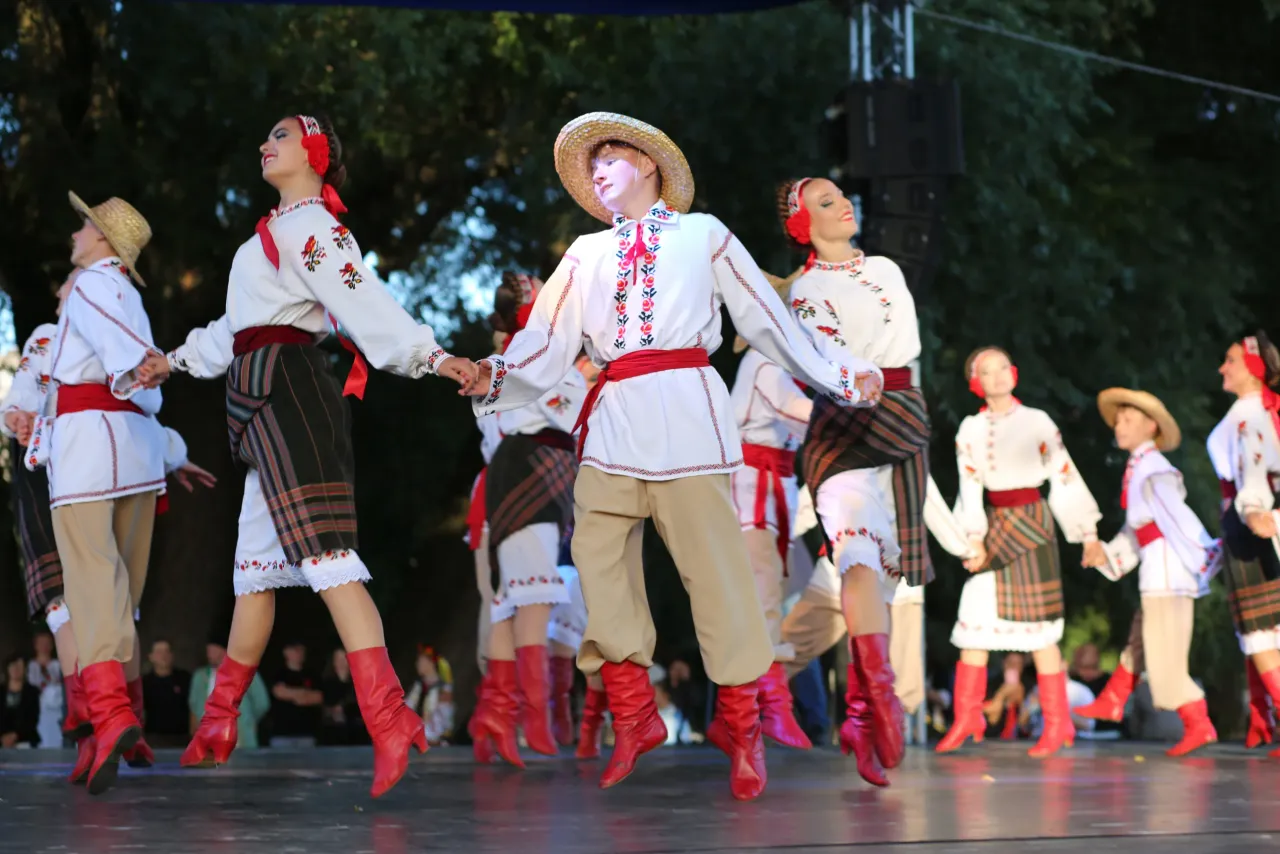
Навчайтеся танцювати разом з нами!
Покрокові відеоуроки допоможуть вам опанувати рухи подільських танців
Перейти до вивчення танцю